The First Version of Uber
The First Version of Uber
[caption id="" align="aligncenter" width="1200"] Photo by TechJuice[/caption]
It was 2008. Garrett Camp, who lives in San Francisco, USA, lamented that taxiing was too difficult.
"I got sick of the taxi that didn't come when I called or stopped even when I stopped."
Then one day. I saw the James Bond movie 'Casino Royale' (2006) and one scene didn't leave my head.
James Bond was driving his car around the Bahamas, and his car was moving with arrow icons on a map in the phone screen.
"I thought of Camp, who had already started an internet company. Can I link this arrow icon to the taxi service?"
"It was just around the time when the first iPhone was released. Can't you make an app?"
No need to call the taxi company, how nice.
Above all, can't it look great like 007?
He talked about the idea with every friend he met.
One of them was Travis Kalanick, former CEO of the billion dollar enterprise.
This is how the first version of the company, UberCap, started.
Fighting Chicken CEO
Camp and Kalanick knew the business would be a tough fight against the established taxi industry.
So, we agreed that it would be good for a start-up to be led by a 'fighting chicken' who never loses in a fight. So the CEO became Kalanick.
Kalanick's fighting cock temperament helps drive the company's rapid growth in the early days.
He was a great salesman and helped raise money.
Also, it is almost as if one company coined the term ‘gig economy’ (an economic phenomenon in which non-regular freelance work patterns are spreading in response to rapid changes in the times).
But what about fighting chickens in general?
In times of war, they show their abilities, but in times of peace they cannot control their tendencies.
The Removal of Kalanick
[caption id="" align="aligncenter" width="1600"] Photo by Quartz[/caption]
It often causes problems. Kalanick causes all sorts of trouble and eventually gets kicked out of the company in 2017.
In fact, in Silicon Valley(Startup Advise from a Silicon Valley Legend), you can't kick the founders out.
There is such a thing as an unwritten rule. It's almost inviolable territory.
This is an unwritten rule that emerged after the late Steve Jobs(Why Complete Honesty Is An Important Leadership Principle) was ousted from Apple in the 1980s.
Still, Uber kicked Kalanick out. That would be proof that Kalanick was at the center of the company's problems.
Uber's rise and fall actually follows the same trajectory as Kalanick's rise and fall.
Two years have passed since Kalanick left the company.
After that, the billion dollar corporation went public, but the market reaction was only lukewarm.
In the second quarter of this year, it posted an astronomical deficit of $5.2 billion.
In the first earnings announcement after listing.
It is rare to see the the success, which once soared to about $70 billion in enterprise value and threatened the automobile industry, taxi industry, and transportation industry at the same time.
Much of this has nothing to do with the culture Kalanick has planted in the company.
Of course, there is a reason why the ride-hailing industry is competitive and low-margin these days, but it is impossible to ignore the influence of Kalanick's organizational culture that has caused the company to lose its way.
"We had a great idea of sharing a car, but the corporate culture that was created in the process of implementing it was quite messy."
CEO-like employees
[caption id="" align="aligncenter" width="700"] Photo by The Economist Executive Education Navigator[/caption]
Kalanick was born in 1976 into a middle-class family in California. He double majored in computer science and economics at UCLA, dropping out in the fourth year.
It was to be dedicated to the search engine Scour.net, where he could download files, including music and movies he made with his friends. So far, it looks pretty similar to Bill Gates or Mark Zuckerberg(History of Facebook Imitation), right?
However, Scauer.Net collapses after being sued by Hollywood.
After that, Kalanick started another internet company and sold it for about $2 million.
In the process, Kalanick appears to be working without any friends or girlfriends. He was determined to make a great company.
He did the same when he worked for the billion dollar enterprise. He only had an idea to grow and make it a great company.
To do that, you need to hire people who listen to you.
Kalanick has hired employees who follow him almost like a cult leader.
The method is relatively simple.
He hires young men with similar rooster tendencies but little experience to himself and takes charge of a city in which the corporation operates. Kalanick left many decisions to them.
They were loyal to Kalanick. Of course, there were a lot of bizarre things along the way.
The Brother + Programmer Culture
In New York, the culture of brother + programmers is so strong that sexual harassment cases have arisen, and in Indonesia, Uber employees have even bribed local police.
This hiring behavior later contributes to a culture of sexual harassment within the enterprise.
Unconditional Victory
[caption id="" align="aligncenter" width="768"]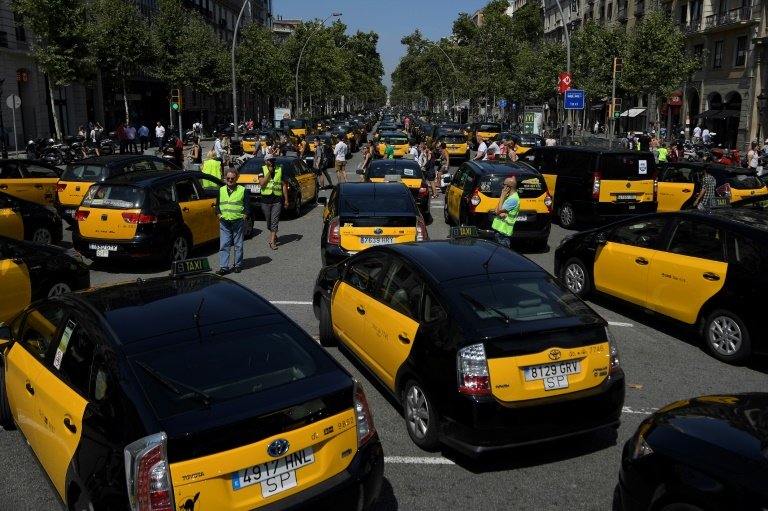 Photo by Phys.org [/caption]
To fight the taxi industry, you need to be convinced that taxis are a thing of the past and the transportational platform set up by the enterprise is the best.
"We need to share the clear perception that taxis are enemies."
Kalanick continued to operate despite the transportation authorities' explanation that the early Uber taxis would pay a fine of $5,000 for each passenger and allow the company's employees to go to jail for 90 days per business day.
Instead, they take the name taxi from Uber Taxi.
The billion dollar enterprise continues to do business that way. The company also hires former CIA and FBI employees to screen out traffic officials, police and prosecutors, and have them download fake Uber apps.
It's similar to the transportation platform, but with this app, no matter how many times I call an Uber, it doesn't come.
In the early days of calling Uber and then evading the traffic authorities' crackdown on fines.
It took the authorities years to find out, and the company had already begun to gain popularity.
This is called a grayball.
Even blatant lies are easy. Since 2014, the billion dollar corporation has charged an extra $1 per ride in the name of the Safe Ride Fee.
He explained that the money would be used for driver criminal background checks, car inspections, and driver training. In the name of these fees, the company took nearly $500 million, but it turned out that no money had been allocated to safety measures.
It was simply a dollar to increase margins.
Competing with Lyft
[caption id="" align="aligncenter" width="1000"] Photo by AppleInsider[/caption]
It was brutally ruthless towards its competitor Lyft. One of Lyft's strengths is its good relationship with the company and its drivers.
Reflecting this, Lyft used to party with candidates to recruit drivers. Kalanick sent his employees to this party
At the party, the company's employees wore black Uber-colored t-shirts and carried bins with the word “Uber” inscribed on them, distributing cookies.
The number on the back of the T-shirt they were wearing was written in large letters, and the driver candidates who came to the Lyft party could receive a bonus by entering this number when registering as a driver for the corporation.
A really terrible thing happened in Brazil. Rio de Janeiro was one of the biggest markets for the corporation. However, there was one problem: passengers mainly paid in cash.
Drivers carrying cash have been targeted by crime and the taxi industry, whose jobs have been lost because of the billion dollar corporation. It was not uncommon to call an Uber and set fire to the car, assault the driver and steal money.
There have even been deaths of drivers. It was a crime that took advantage of the blind spot that only an e-mail or phone number was required to register as a passenger.
Is The Billion Dollar Corporation Safer than The Taxis?
The company insists that it is safer than taxis, but only after a long time makes the passenger registration verification process complicated. But that was after more than 16 drivers working for the company had already been killed.
Behind these delays was an obsession with Kalanick's growth and an attitude that the driver didn't care about.
It's always happening in the corporate world to go overboard and beat competitors to grow.
However, the company's 'unconditional growth' and 'unconditional victory' feel like it went too far.
At the center of this vortex was Kalanick.
This is the reason why some are criticized for saying that the fighting chicken Kalanick's tendency had too much influence on the operation of the corporation in the early days.
Excessive Partying
[caption id="" align="aligncenter" width="3000"] Photo by New York Post [/caption]
In October 2015, thousands of employees working for the giant enterprise gather in Las Vegas.
Hundreds of hotel rooms were reserved and each employee was given a prepaid card.
They also gave us a wristband, an identification device that allowed us to enter the party organized by the company.
There was a party every night, and the final night event ended with Beyonce.
She sang the most popular singers to company events.
It was later reported that Beyonce received $6 million worth of the company's stock for her participation in the event that day.
The total cost of this Las Vegas employee event was a whopping $25 million.
Such excessive partying is not irrelevant to Kalanick's tendencies.
In various media interviews, Kalanick goes on to say that her Uber fame has made it easier for her to find a date.
When she uses derogatory words for women, she does. His appearance was enough to make the public see him as a feminist.
Messy Legacy
Kalanick's behavior is reflected in the organization's culture. Former employee Susan Fowler made this point in her blog post in February 2017.
From the time this article was posted, the downfall of Kalanick actually begins.
The company's corporate culture, created by young male employees who resembled Kalanick and followed him like an idol, is probably a 'video even if you don't see it'.
New York Times reporter Mike Issac points out in his new book that many of the company's problems are ultimately due to Kalanick's tendencies and the organizational culture he created.
He explained that when the enterprise was a small privately held startup, it was a level of deviation and eccentricity that could have been overlooked, but it pursued a method that was not suitable for a company with many stakeholders, including shareholders.
Even after his resignation, Kalanick said he struggled to control the the corporation.
He overheard meetings and demanded figures and data from his close associates.
But now this company is being led by new Expedia CEO Dara Khosrowshahi.
Erasing Traces of Kalanick
It is struggling to erase traces of Kalanick, but the difficulties are compounded by the overlapping of unsuccessful IPOs and astronomical deficits.
Khosrowshahi even hinted that the company might run into a deficit through 2021. It's suffering a loss, but is still running.
Of course, it does not live up to expectations.
You won't be able to blame the founders and CEOs for all of the company's problems. However, it is also true that the personality of a founder has a huge impact on the organizational culture and operating method of a company.
When we talk about this company, corporate culture is not easy to change once established.
The facts are also exposed. It must be said that building a good corporate culture from the beginning is just as important.
I can't wait to see if this company can get on with this messy situation that Kalanick created and left.
For more articles lie these, please visit Business Stories at Ulzzang Korea: A New Way to Knowledge!

Comments
Post a Comment