Leadership tips for middle managers who want to be as effective as their juniors
Leadership tips for middle managers who want to be as effective as their juniors
I have been working hard since I was a freshman, building a lot of competencies, and recording high achievements.”
“Thanks to him I became a middle managers much earlier than his peers”
“But, something is strange. Subordinates who care and consider them more than anyone else are not doing their jobs properly.”
“I often have a dissatisfied expression on my face, and the team’s performance is increasingly disappointing.”
“I went to leadership training here and there, wondering if it was because of my lack of leadership.”
“I’ve read a lot of books about successful managers and leaders with leadership tips .”
“But I don’t know. I am not a person high enough to take responsibility for a company, nor is it a company I created, so it is not easy to apply it in reality.”
/leadership-definition-2948275-Final-5c890d7846e0fb00010f1190.png) Leadership: What Is It?[/caption]
Leadership: What Is It?[/caption]There are readers who will become “middle managers” now or soon.
As I took on the work of a part rather than an individual, even a few people
You need something called 'management' (WHY THE ‘OWNER MANAGEMENT VS PROFESSIONAL MANAGEMENT’ DEBATE IS MEANINGLESS?).
However, this middle manager job is more difficult than expected.
If it's personal work, I can do anything well, but I can't do this or that because I'm stuck in the middle.
The responsibility is great, but the lack of authority makes it difficult to demonstrate proper leadership.
After becoming a middle manager, like when I was a junior with high performance, I want to work even harder to make more results, but a middle manager who doesn’t seem to be doing well at any job!
What the hell should I do?
In junior days, you can 'work'. Junior staff, so
It is clear how to do a job well if you are on a senior level from a freshman to an assistant manager.
“I do what I am asked to do, and I do what I am not told to do”
To put it in a nicer way, you need to have high 'self-direction' in your work, but also have high 'acceptance' to your boss's instructions.
If you put this attitude as the basics and have a very deep practical understanding of your work, you will be rewarded.
[caption id="" align="alignnone" width="603"] Middle Management Leadership[/caption]
Reality of Middle management Level
Of course, this is by no means easy, and you can omit one or two.
Basically, if you are proactive and sincere, you can get into the top 30%.
It would be great if you worked for 5-8 years while maintaining this look every year.
In particular, if you have consistently worked with this attitude in an organization, you will be highly appreciated.
Hearing the story of 'promotion rank 0', you'll come to believe that you're pretty good at your job too.
But what if such a talented employee gets a job titled 'Chief' and becomes a middle manager with even a small amount of work control and personnel rights?
[caption id="" align="aligncenter" width="638"]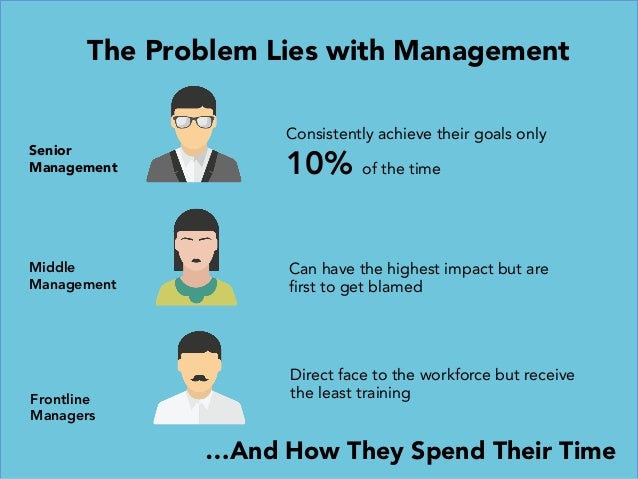 Middle managers struggles[/caption]
There are times when you are suddenly in trouble, and you are caught up in conflict.
I often hear stories about 'not getting results'. I was really good when I worked alone, but I wonder why I don't get results when I work with employees. It's easy to scold the staff for being too skinny, lazy, and brainy.
However, it is the job of the “chief” of the organization, whether large or small, to bring them to fruition.
As such, ‘I thought I would do well even if I became a boss… ’ You will be thinking the same thing.
Why Middle managers need to 'make it work'?
As mentioned above, when you are in a lower position, you can concentrate on the given problem and work hard while looking for more necessary things according to the situation.
However, when there is a subordinate who has to take responsibility, and when performance is given to the shoulder rather than an individual part or team, other abilities are needed from then on.
It is ‘the ability to make things work’. “But isn’t this just leadership?”
Yes. leadership! However, it is a little different from the leadership tips we usually encounter.
Above all, middle managers are literally ‘beings in the middle’.
Responsibilities, especially for members and performance, are given very heavily, but they have little authority.
The right to conduct work is poor, and there is no right to select or train team members. Personnel evaluation powers are usually very limited.
As a result, it is difficult to form a proper team, and even if a team is in place, there are not many ways to lead it strong.
The limit is to listen to a story about buying alcohol or coffee, or to swear at the company while swearing at each other.
It's just a 'homework' given by superiors. Often they even give performance goals that they don't agree with, don't understand, or that are impossible to achieve.
Even if you are not motivated, you can't just shout out to the staff, 'Attack forward'.
Even in such a situation where hands and feet are tied, middle managers have to make it work. It requires skills to derive results through various direct and indirect efforts.
In other words, it is leadership that allows a small number of subordinates to get the most out of the team as a whole, with little intervention from me.
'Leadership that makes things work' for middle managers.
1. You must learn to wait.
People who do well in lower positions usually have a strong sense of responsibility and a strong desire for achievement. It means that you have a very strong tendency to do something yourself to get results.
The most difficult thing for such a person is to “not do” something.
Middle managers probably don't have more options than employees. In the past, if your boss didn't like you, didn't agree with your goals, or if the organization didn't motivate you, you could just put your head on the monitor and focus on your work.
Middle managers will be humiliated if they do this.
For this reason, the first virtue to be learned as a middle manager and the first competency to make it work is ‘waiting for the right time’.
It's deliberately slow working until things get better for you over time.
If the circumstances are good, you can just run.
However, when the external situation is not very good even though there is no organization and work choice, it is difficult to work out if you try to push ahead with work.
There is a lot of room for me to be offended, burn out, or have conflicts with my colleagues and bosses around me.
Even though the middle manager in the sales department is unable to do anything because of Covid-19 and is unable to produce results,
Even if you go to the customer company while urging your employees, it is easy to ruin the relationship without getting anything.
It's much better to come up with a plan on how to quickly restore the market and capture sales when the situation improves, and think carefully about whether there will be a different approach.
For team members who have not been able to take care of them due to busy schedules, it would be good to find ways to help them with their abilities or careers.
2. You must hold onto your mentality.
Of course, even having such a long breath is not acceptable to middle managers.
No matter how long you take a breath, your boss is begging you to do something right away.
In this situation, it is an unreasonable request to tell a person who is responsible and self-directed with a strong desire for achievement to ‘wait’ or ‘needs internal maintenance’.
However, middle managers cannot solve problems with actions, that is, actions alone.
The powers are poor compared to the responsibilities given to them. Solving problems with this little power requires choice and focus.
You have to wait and break through the obstacles in one shot, aiming for the right timing. So, if you are in an organization that is more impatient than me and shouts ‘Do something!’, you must first decide whether you should act or wait in this situation.
What if waiting is right? It takes effort to convince your boss to wait.
Middle managers do not set goals or have much authority. That doesn't mean it's less responsible.
You have to keep exploring how to move around as efficiently as possible.
When you crouch like this and gather your strength, you can work hard when you really need it.
To do this, you need to develop the mentality to withstand the pressures of those around you, especially your boss.
https://www.youtube.com/watch?v=C0W4H6jMLKg&ab_channel=SimonSinek
3. You must remain motivated externally.
However, it is good to put one's gaze in the center and see the timing according to one's judgment, but if you do this, it is easy to look like an idiot who doesn't work or an employee who rebels against the boss's orders.
“In the old days, you worked hard, but you don’t work after being promoted?”
You're going to hear something like this.
When the situation is unfavorable or there is a lot of uncertainty, you should explain the situation and persuade that maintenance is necessary rather than blindly ‘let’s do our best because we made it happen’.
Of course, in order for this figure to be trusted, you have to show that you are doing your best on a regular basis.
And the reason and the rationale for the approach that is different from the usual should be calmly organized and delivered.
In other words, it is necessary to clearly convey the opinion that now is not the time to lose power, so that the perception that ‘I am not playing’ is made.
However, the boss can insist on strict enforcement. At that time, you have to accept it and change to assault mode again.
It is partly because office workers cannot insist on their own opinions, and partly because they must always show that they are responsible for the things they have been thinking about in their heads.
4. Do not vomit your feelings to subordinates.
 To practice making things work, you need to try not to convey your feelings, especially negative ones, in your normal dealings with your employees.
* Positive emotions are excessive,
As long as it doesn't give you a feeling of favoritism, it's good to pass it on.
If you keep expressing negative emotions and hurt your relationship, there will never be a situation in which the work of the subordinates will only go away with the efforts and talents of the subordinates.
Relieving your stress by exposing your feelings to your employees is the easiest way to make enemies.
You don't have to make enemies just because you don't show loyalty.
Points to be pointed out should be conveyed in a cool, one-to-one manner, but be careful not to feel emotional, and absolutely avoid scolding employees in public.
another one. When leaders say they need to control their emotions, they interpret it as ‘don’t be annoyed with subordinates’. There are more negative emotions than irritation. That's anxiety.
When a person gives orders in a state of anxiety, it is easy to read them as coercive instructions that are hard to trust and difficult for subordinates to agree to.
To get work done without being proactive, you need to make sure that your employees have the minimum motivation (Learn More: HOW TO ADAPT TO ‘CORPORATE CULTURE’ FOR ORDINARY OFFICE WORKERS) to want to work for you.
To do that, we must not show emotions that can make us enemies or break trust.
5. Don't trust it in business.
You should have an attitude of trusting your team members about your work or performance, but it is difficult to trust too much at work.
You don't have to exist if you want them to do their job perfectly, without direction or supervision. When giving work, give it with confidence, but when the deadline is set, you must carefully check it.
The point here is that once you set a deadline, you should never change your mind, reschedule, or do an unscheduled mid-term inspection.
Changing the agreed-upon schedule due to changing circumstances is fine as long as it is sufficiently explained.
But anxiety grows in the back of my mind, and checking mid-way through or constantly changing schedules is fatal to mutual trust and, above all, completely destroys the desire to work for me.
This is because attitudes like homework checks are accepted as 'I have no respect for you at all'.
This is what the phrase 'humanly believe' means.
Once an agreement is reached, it is respected as much as possible.
And if there is something really lacking, when the deadline comes, you can just smash it.
At that time, the other party also appears in anticipation of it, so you can go to an atmosphere that empathizes with the need and method for improvement rather than consuming emotions.

“Then what should we do with an employee who is not usually suspicious?”
From the beginning, the mid-term inspection cycle is shortened, and tasks are instructed as specifically as possible.
To an employee who can't work or is not responsible, you can entrust the job in a simple task unit, tell them that they inspect it 3 times a day, and actually do that.
What to do with a good employee?
You can manage it by entrusting a large and complex task and discussing it again in a week.
You shouldn't say a word about this for a week.
This way you can give your employees a sense of trust without leaving a hole in their work.
6. Thoroughly manage priorities.
It is a tremendous task in itself to distribute and check tasks very systematically by each employee and by task to a middle-level manager who lives with his work.
You have to approach work in a much more systematic and structured way than when you work alone.
What is needed for this is 'structuring'.
Structuralization is the ability to -set work goals -organize detailed tasks (tasks) necessary for it -determine priorities within detailed tasks.
For middle managers, this structuring is continuous.
Whether it's a routine, repetitive task, or a project that has deadlines and goals, and requires focused energy in a short period of time.
[caption id="" align="alignleft" width="472"] Setting Priorities for Middle managers is important[/caption]
You should clearly communicate this to your team members, and you should not neglect the practice of reporting and checking the results on a regular basis.
This ability is also essential as you go up in ranks such as team leaders and executives beyond middle managers.
If you are starting a business, it is important enough to be a factor in determining the success or failure of your business.
It's easy to overlook when you're young because your boss sets your priorities.
But if you become a middle manager, it is an ability you absolutely need to practice.
Always think of structure, set up your work system, and keep your priorities in mind.
Let's summarize the long story.
When I was a junior, I worked hard and heard the story 'I do a good job', but after becoming a middle manager, I want to do more work.
It's a good attitude, but unlike when you're working alone, if you have subordinates, simply driving or dragging them doesn't yield results.
This is especially true for middle managers who do not have authority and have only a lot of responsibilities. That's why you need to wait patiently and measure the timing to pour out your energy.
This is especially necessary as you become a manager if you worked very hard as a child.
This process burns my stomach and makes me feel frustrated and even think that I have to do it.
However, if you do not learn how to wait at this time, even if your authority is increased later, you will only peck, crave, and drive your employees, but you will not be able to develop an attitude toward working for your boss and for the organization.
It's an atmosphere where we have to slow down one tempo because of the corona problem.
How about using this time to look back on your attitude as a manager and think carefully about how to make it work? must grow.

Comments
Post a Comment