How Susan Rogers 'choice' changed her life, From high school dropout to producer of a legendary pop star
Susan Rogers, a full professor at the Berkeley School of Music
[caption id="" align="aligncenter" width="1600"] Susan Rogers[/caption]
Susan Rogers is a full professor at the Berkeley School of Music. She is considered one of the most popular professors at Berkeley College of Music, and in 2012 she won the Best Professor Award.
She was originally a successful sound engineer and producer.
She is best known for recording her album 'Purple Rain' during Prince's prime in the 1980s.
Although she is successful in the music world and is living a happy life as a professor, her life has not been easy from the beginning.
The story of Susan's life
Let's hear the story of Susan's life. Susan lost her mother to cancer at the age of 14.
She was forced to take on the chores of a large family, and after her father remarried, she was plagued with constant conflicts and fights with her family.
She eventually married her older boyfriend, Susan, she dropped out of high school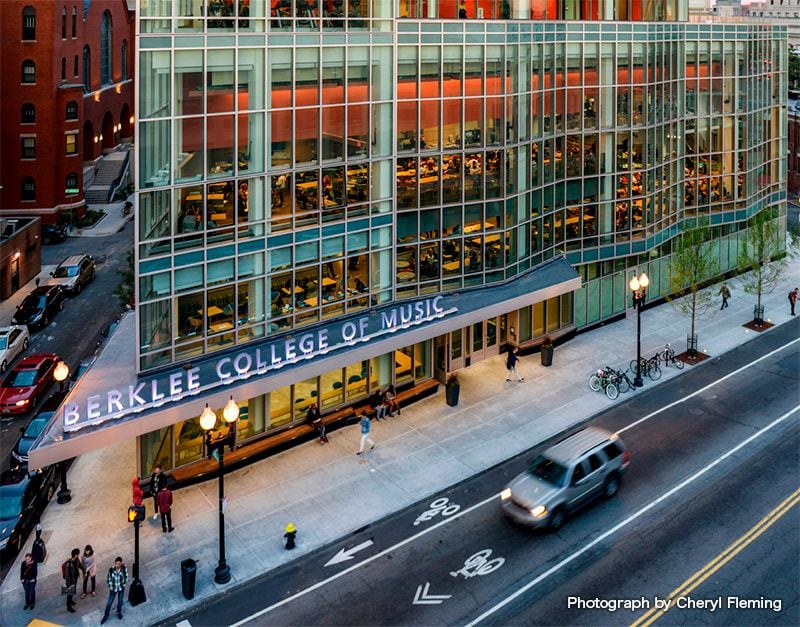
I thought that if I got married, I would be able to be independent at home and be protected by a man older than me. “It was a naive idea now that I think about it,” she said.
Susan's husband was very ill.
If he suspects that he is seeing her other man, he turns ferocious and uses violence at Susan.
When she was having a hard time since her childhood, she found solace in music.
Her husband was also jealous of Susan's interest in her music. She used to shatter records.
She sat at her table one day while she was doing graffiti without thinking when her husband approached Susan and yelled at her.
“Why don’t you draw a big cock like a rock star and suck it?”
Susan exploded in anger at that moment.
She just left the house and filed for her divorce.
Her free (pompous) Susan gets her first chance to 'choose' her own life.
She didn't want Susan to go back to her school studies, or to go back to her factory work.
Her biggest motivation for Susan was music. She weighed her own micro-motives one by one.
She usually wants to be a rock star if she has a passion for music, but she says Susan is not attracted to her singing or playing instruments.
She said Susan and she took pleasure in taking care of others.
She found great satisfaction when others recognized and valued her own help.
Susan was also interested in her engineering-related work. She loved making simple gadgets and electronics.
She enjoyed understanding how things work, and in that way she loved science.
She finds out about her 'sound engineer' while trying to figure out a job that would fit her own motivational combination.
“She pondered it, and then a thought occurred to her,” she said.
“She said being an engineer in a recording studio would be fun for her,” she said. “She can help musicians, and she can handle the equipment, so she’s excited.”
But there was a problem.
Susan's Career Choice
To become a sound engineer, she had to have a professional degree.
To get her degree, she had to go to college, but Susan said that she had dropped out of high school and she didn't have the money to pay her tuition.
At the time, sound engineers were reserved for men. She didn't have any of her contacts for help.
This is when she puts Susan at a crossroads in her choices.
A) resume her studies and pay her tuition
She somehow collects and gets her degree.
B) She got a job as a college administrative staff
She seeks a chance to turn into an engineer
If you were Susan, what would she do?
She says 'When you have to make a career choice'
Susan's story appears in Todd Rose, Ogi Ogas' book Dark Horse
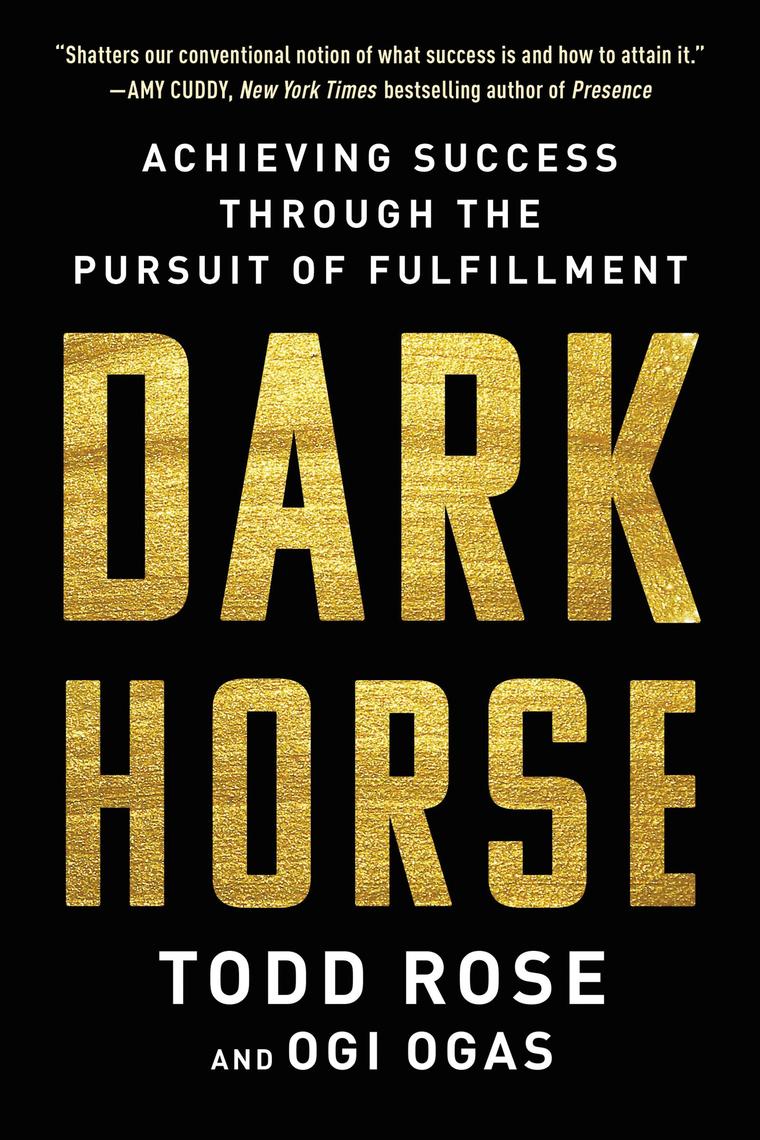
Dark Horse's Advice Susan's story appears in Todd Rose, Ogi Ogas' book Dark Horse.
She's a book about how individuals can break free from the meanest system.
The authors studied 'dark horses' who succeeded by forging a unique and unique path, rather than a typical path to success.
She was a capable political aide, then became an organizing consultant, a single mother who dropped out of middle school and became a world-class astronomy professor. She majored in linguistics, then dropped out of school and became a world-class poker player, etc. Susan Rogers, introduced earlier, is one of them.
To summarize the principles drawn from the lives of these dark horses:
(1) Identify her own micro-motives.
(2) Choose based on suitability, not a probability.
(3) Develop your own strategy.
(4) Abandon destination-oriented thinking.
The first principle of Susan
In the last article, ‘If you want to make a living doing what you love, look for ‘small and trivial motives, she talked about her first principle, ‘micro motives’.
Today I want to talk about the second principle. This is the principle of ‘choice’.
What is fit?
Imagine you are a bird. You can choose and buy anywhere you want.
Where would you like to live?
Amazon rainforest?
Tibetan Plateau?
The beach in front of Incheon?
To know the answer, you must first know what kind of bird I am. Antarctica would be a good fit for penguins
If you are a hummingbird, you should go to a warm forest with many flowers.
This is the concept of ‘fit’. It's about how well one's personal characteristics fit into the environment around them.
It seems natural for birds to consider suitability when choosing a habitat.
Isn't it strange to choose a place where a lot of other birds live?
As the dark horse authors point out, 'But people don't often do that when they choose a career path'.
As we shape our careers, we continue to be faced with choices.
In the usual (average) way of thinking, we consider ‘probabilistic risk’ when evaluating options.
Let's say that only 1 out of 100 non-computer science majors who apply for Google Engineer will pass.
Then, applying for a non-major to become a Google engineer is not
It's a very dangerous and wrong choice.
It's like assessing risk from the point of view of a person who has to pick one out of thousands of applicants.
If there are people who have succeeded in doing so, I think they are very lucky. Are you not used to it?
When we set out to do something, we eagerly look for information on how many people like me have gone down that path and how successful they are.
How many cars were the competition, and how many people had the same specs as me?

In other words, statistical probability is very important. ‘Dark Horse’ doesn’t.
Because we have a combination of talents and motivations unlike any other. There is no average person in the world
The ‘dark horse’ judges suitability instead of probability.
The criterion for judging suitability is one's own small and trivial motives.
I weigh how well my micro-motivation combination fits with the characteristics of the options in front of me.
The better the micro-motive and the choice fit, the more I can work with passion, the lower the risk of that choice.
On average, how many people make this choice and how successful it is not the “reality” of the choice.
‘How well this choice fits with my unique characteristics’ becomes the reality and possibility of the option.
Let's go back to the situation of Susan Susan who chose B.
What was Susan's choice?
A) She resumes her studies and somehow saves her tuition to get her degree.
B) She gets a job as a college administrative staff and seeks a chance to turn into her engineer.
If you look at the general mindset, of course, A is correct.
None of the sound engineers didn't have a degree.

So it's a very risky choice for her to do something without a degree. After preparing hard, it is 'realistic' for her to somehow get into college.
But Susan chose B. She got a job as an administrative employee of a college with an acoustics department!
She makes such a reckless choice. She wants to learn sound engineering, but what if she gets a white-collar job?
How many people have turned to engineers after getting a white-collar job?
But Susan had a good understanding of her own motives.
She said she was confident she could do a desk job, too.
As she worked as a white-collar worker, she saw that she would gain the knowledge and connections to become a sound engineer.
Shortly after her new job, she hears information about her 'maintenance engineer' job over her shoulder.
In fact, sound engineers and mechanics are different things.
Maintenance technicians are not in the spotlight. But she thought Susan would suffice if she could get a job in the music-making scene.
She self-taught Susan, where she obtained an electronics textbook, and she took her job as an apprentice maintenance engineer for a sound technology company.
How can I forget the moment my career began."
"I don't even know how I got selected. What is certain is that I was very enthusiastic about the interview. I must have been the first person to be so eager for an apprenticeship."
She converted the passionate Susan into a full-time job at her company, and Susan traveled to recording studios throughout Los Angeles for her maintenance services.
Here comes another opportunity.
One of her clients, Rudy Records, one of her top agencies at the time, noticed her Susan and offered her a job.
Susan becomes a mechanic for Rudy Records. Rudy Records' musicians performed a lot of live performances. At the venue, Susan worked as an assistant for her sound engineer.:format(jpeg):mode_rgb():quality(40)/discogs-images/L-1658778-1561568496-5052.jpeg.jpg)
She finally got a job mixing the sounds of famous musicians. She was 24 years old at her age.
She said Susan made the reckless choices she had low odds of, was she just lucky?
“People say this. Succeeding in her music world is like standing on her shoulder on her highway with her thumbs up and waiting for her car to pick up."
"But it wasn't like that in the music world I was exposed to. I never stood still. I walked."
“I finally got a car and rode it, but the reason I got that kind of help is that someone saw us walking and everyone likes a forward posture.”
"Dark horses don't wait for passion to come, they design it by combining their own motives"
“A good way to design your passion is to look at the inherent fit of your motives, not your probabilistic risk when evaluating the options before you.”
"She hopes to be a sound engineer, and when she gets a job as an administrative employee, Susan doesn't just roll her dice"
“It was a decision she made because she thought the nature of the opportunity and her personality was right,” she said.
"Thanks to her passion for designing her, she was able to walk silently along the shoulder of the road. She didn't have to wait anxiously for someone to pick her up and yo"
(Dark Horse author Todd Rose)
Evaluating options in terms of probabilities makes us powerless. 'Who is a woman who has succeeded as an engineer? I don't think that's the way
'I'm a local university student, but few people have joined that company. that's not my option
to become someone? You're very lucky.' From this perspective, those who deviate from what society sees as the norm have very limited options.
However, in the dark horse mindset, ‘self-understanding’ is more important than luck.
The best in the world must be lucky. But I can make the choice to find the place that suits me best.
That's why dark horses go down a different path than most people think of their career path.
I'm going down a very winding path in my life.
But as a result, he is the most satisfied,
You will achieve goals that you think are meaningful
Susan's Re-challenge Another opportunity comes to Susan, who was walking on her shoulder.
She is Susan and she has been a Prince fan for a long time, and she sang, 'How I wish she would be when she became the Prince's engineer'.
Her acquaintance, who knew her like that, told her that her Prince was looking for her mechanic.
“I was happy to run. But looking closely, she had her own reasons for such a precious position.
When she became Prince's mechanic, she had to go to Minneapolis, Minnesota."
“At the time, Minneapolis was like a barren country for music. All my friends told me that going there would ruin my career.”
Now she looked like a risky choice for Susan, who had built her own career foundation.
But when she said Susan she did not hesitate and packed her bags.
At first, Prince seemed to ignore her Susan.
But she said that Susan had proudly expressed her opinion of herself.
[caption id="" align="alignleft" width="544"] Prince from the purple rain[/caption]
As she spreads her technical knowledge, she gradually earns the Prince's trust.
The two had a good taste in music and their sensibility. Susan was hired as her mechanic, but even when recording her tracks, Prince called Susan to her console.
The album they recorded was ‘Purple Rain’. Purple Rain became the most successful album of all time, selling over 25 million copies.
Prince has won two Grammys and an Oscar.
She too was word of mouth in her music world, and her role as her producer changed.
She established herself as a successful music producer in the 1990s as she produced albums such as David Byrne, Selena, and Rusted Root.
But the funny thing is that Susan's story doesn't end there.
She quits her position as a successful producer and begins her studies at her college.
She suddenly became interested in her 'human brain' while Susan worked as her producer.
She wanted to study the connection between music and the brain, and she felt a strong attraction to it.
Here again, she makes a choice based on suitability and not probabilistic risk.
Susan ended her thriving music career at 41
At the age of 41, she ended her thriving music career and entered college.
“She was very motivated to learn brain science, but she was concerned that her ability to learn would diminish as she got older, which she was terribly concerned about,” she said. Her college years were the freest four years of her life. "
She was obsessed with learning and studying.
 Dark Horse author Todd Rose[/caption]
She had a clear goal, and she knew what she wanted to do. She had a really great time.”
After completing her Ph.D., she took a professorship at the Berkeley School of Music, Boston.
"Susan's career is a good example of 'the pursuit of fit and great achievements'"
“In the era of standardization, striving for excellence comes with a sense of satisfaction. But dark horses seek satisfaction, and the result is superiority.”
(Dark Horse author Todd Rose)
Not just Susan, but the lives of countless others she has worked with on the Dark Horse Project.
Instead of wandering in search of big and colossal motives or calculating probabilistic risks, she made her own satisfying career thanks to her choosing to look at fit, not odds, without forgetting the slight attraction she felt.
How are you?
When given career options,
Do you calculate probabilistic risk and choose? Or do you choose according to the suitability with yourself?
Read Also: Why did Bob Dylan sell his music?, Interesting Facts about Jeff Bezos: “Only 3 Decisions a Day”

Comments
Post a Comment