How Alibaba dominated Ebay in just 7 years
How Alibaba dominated eBay in just 7 years
Alibaba is going through the worst times
For Alibaba, 2001 was indeed the 'worst time'.
Thanks to the dot-com craze, he received a large amount of investment from SoftBank Chairman Son Jeong-eui, a Japanese IT giant, and received high expectations as a next-generation e-commerce player, but Ma's clumsy management judgment ruined everything.
He wanted to create a global business infrastructure while seeking to expand users.
So I moved my office to a good place like a founder who was blown away by a small success, set up numerous overseas branches, and recruited a large number of high-spec talents.
However, the absence of a clear business model has led to a deterioration in profitability and financial position. Alibaba was forced to undergo intensive restructuring.
In this regard, Porter Erisman, head of marketing, recalled the situation at the time:
"Ma Win was always full of confidence. But he said this in a weeping voice."
"People look at me and curse at me, I thought it was the best thing to do. Am I right that I did something bad?"
"I replied that it was a reasonable decision, but I was worried about who could be the supporter of the organization if his mentality collapsed."
I managed to catch my breath, but...
Alibaba had to make money. So, he decided to receive the offline exhibition participation fee and entry fee for the participating companies.
Fortunately, the business settled down and took a breather, but it was still difficult to cover operating expenses.
The deficit continued to accumulate. Alibaba's management realized that a breakthrough was needed, and they considered it a second business item.
The easiest thing I could think of was the C2C open market. As I was about to prepare, I heard ominous news.
In 2001, the news was that eBay had bought a 33% stake in Ichinet, a leading C2C company in China, for $30 million.
Ma was concerned that eBay might use this as a bridgehead to enter the Chinese market directly.
The fear has become a reality. Sea sharks enter China's coast
The C2C open market prepared by Alibaba was unveiled in 2003. It was Taobao.
Ah, I can get confused here. If Alibaba is a company name and a site for business-to-business (B2B) transactions, Taobao is a second business item and a site for user-to-user transactions (C2C).
Anyway, at this time, eBay announced a major issue. It was decided to acquire all remaining shares of Ichinet for $15 million. At the time, eBay expanded rapidly under the leadership of its former female CEO, Mac Whitman.
After a long career as a marketing professional, Mac Whitman led the company for over 10 years, until 2008, when she was hired as an eBay Professional Executive in 1998.
It was a myth that grew a 30-employee company into a $92 million company in sales.
In particular, when eBay entered China, it was the time when it acquired PayPal, a payment company, and set up branches around the world.

What if Ichinet, which already maintained a market share of 70-80%, and Mac Whitman's eBay, whose ambitions cannot be grasped, merge?
A very difficult fight to win Alibaba's money was less than 10 million dollars, and internal and external crises continued to occur.
First, due to the SARS outbreak at the Chinese headquarters, many Taobao team employees were unable to go to work and were forced to work from home.
It was only natural that things were not going well. After some twists and turns, I managed to create a service, but this time the marketing didn't work out.
This is because eBay has already signed a contract with a large Chinese portal site ahead of time, and this includes a clause that prohibits it from placing advertisement orders with the same company.
Yes.
It was a battle no one could win. eBay's chief financial officer (CFO) Rajiv Duta said in an interview with the press, "The Chinese business will be a huge business that surpasses that of the United States.
It was enough to say, "We did a head start (we had an advantage in the early game)."
Yangtze river crocodiles attract sea sharks
During this growing crisis, Ma Win's potential as a manager explodes.
He looked at the situation coldly and wondered how he could win.
In the end, he decided to go simple. He decided to use a strategy to maximize his strengths and bite out his enemies' weaknesses!
Then, what is Alibaba's strength? It has been in the e-commerce business for many years, has a close relationship with existing customers, and knows the sentiments of local users well.

So, from service planning to design, development, and follow-up management of Taobao, we decided to thoroughly cater to Chinese tastes.
Marketing also advertised on small and medium-sized websites instead of large portals, saying that if you have teeth, you use your gums, and sought viral (spreading word of mouth) by marketing cultural content such as theme songs and promoting events on your site.
Next, we bit on eBay's weakness. What is its weakness?
As a publicly-traded company, it has many shareholders. There was a lot of pressure to produce tangible results right away.
Moreover, as large-scale M&A expenses were executed, the voices of investors were even louder.
Alibaba saw through eBay's massive firefights that it never lasted long.
So, it is too early to announce special measures in line with this.
To maintain the free policy for 3 years! Of course, eBay wasn't unaware of its weaknesses either.
I was well aware that long-term investment and effort must come first.
However, it was very difficult to implement a free policy like Taobao with thousands of dollars already invested.
In the end, they adopt a pay-as-you-go strategy.
Yangtze river crocodile bites the neck of a sea shark, but as time passed, the tide turned toward Taobao.
Users quickly adapted to the familiar service, the public was enthusiastic about the small marketing, and the vendors were shaken by the free policy.
The atmosphere is reflected directly in the numbers.
In 2003, eBay and Taobao's market share was 72% and 7%, respectively, but in 2004 they reached 64% and 25%, and in 2005 they reversed to 36% and 58%.
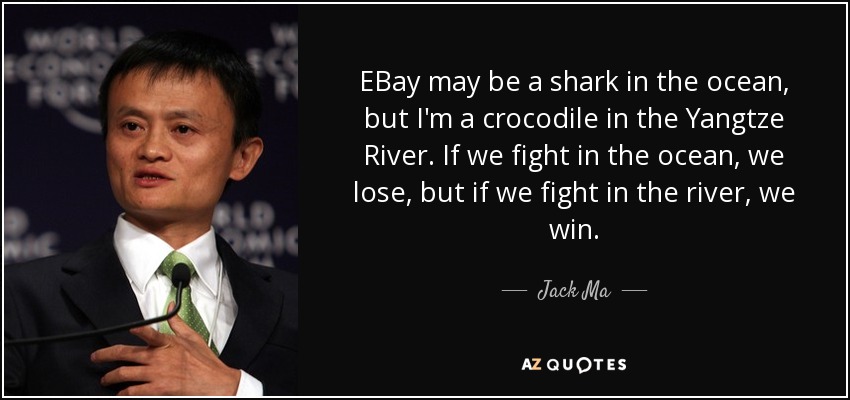
Jack Ma is happy to say that if eBay is a sea shark, Alibaba is a Yangtze river crocodile.
Even if it's overseas, we win in China."
And in time for the eBay earnings release, we prepare a blow of conversion. That is to extend the free policy for another 3 years!
Embarrassed, eBay decided to invest another $100 million in the Chinese market, but it was too late.
The gap widened to 29% and 60% in 2006.
In 2007, it was 7% and 83%.
In the end, eBay decided to withdraw from the Chinese market. Hundreds of billions of dollars lost...
The offensive by global companies? Get your home advantage!
The battle between Alibaba and eBay is a good example of how David can win the battle between David and Goliath and how a local company can win the battle between local and global companies.
In the current IT industry, global companies are stronger than ever.
Apple, Google, Facebook, Twitter, Instagram, and YouTube are making progress as global companies in almost all fields.
From large companies to startups, CEOs and planners think their heads will explode.
It's hard to materialize, but "Maximize your strengths and bite your weaknesses"
I hope this formula will give some inspiration and hints for solving the problem.
If you lose the war anyway, you will die, regardless of the means within the legal framework.
Alibaba's strategy to free Taobao has been criticized for delaying the timing of sales and ruining the ecosystem.
He properly attacked the biggest weakness of foreign giants, the lack of time and the inability to focus on one country, and ultimately led the fight to victory.
Lastly, if there is one more thing to mention besides excellent strategy, it is the strong trust of our internal and external partners.
Despite the worst time, the early members hardly went out and kept the company.
It is because of the trust in the founder and love for the company.
Perhaps the saying that the success or failure of a company is all about organizational culture, not a business strategy and profit model, came from here.
Also read: https://www.businessinsider.com/here-is-the-story-of-alibabas-rise-2014-5

Comments
Post a Comment