Economic moat: The trendy investment method that makes you feel comfortable
Economic moat: The trendy investment method that makes you feel comfortable
Recently, there have been days when interest rates have risen and stock prices of growth stocks have fluctuated significantly.
Investors betting on superstar CEOs and their vision for the future are grim.
Is the 'new era' over? Growth stocks are over, so should I buy so-called 'value stocks'?
These discussions usually lead to exhausting debates without answers.
The notion of an 'economic moat' can help make up your mind.
Getting familiar with Economic Moat
How are you familiar with the concept of an 'economic moat'?
If you've been investing for about three years, you've probably heard the term in a debate, not a debate, between Elon Musk and Warren Buffett.
(Although known as Musk and Buffett's argument, there are many things that are vaguely suggesting that the two actually fought.)
At the time, Elon Musk said, 'The economic moat is a lame concept. The speed of innovation is more important.'
Comparing it to a company like Buffett's favorite 'Seeds Candy', the concept of 'economic moat' does not sell very competitive products, but it contains the nuance of a joke of raising prices based only on brand value. There was.
I'm not blaming Musk (it was a third party that ignited the debate, and Musk likes to fight), I'll just point out that the concept of an 'economic moat' he quoted was a narrow view.
Musk seems to regard the 'economic moat' as an image that seems to be confined to the castle and only defensive.
The 'economic moat' is actually a concept that emerged when dealing with growth stocks.
In the 1970s, Warren Buffett began to focus on the value that intangibles can create, abandoning the old investment method based on tangible assets.
When Berkshire Hathaway acquired See's Candy in 1972, it paid three times its book value.
This was quite unusual compared to the way Buffett or his mentor, Benjamin Graham, was investing.
https://www.youtube.com/watch?v=iQxccekQxrA&ab_channel=ChrisHughen
Since then, it has invested heavily in companies with high growth potential, such as Coca-Cola.
These two companies are regulars when discussing 'economic moat'.
Around this time, Buffett said he was influenced 85% by Graham and 15% by Philip Fisher.
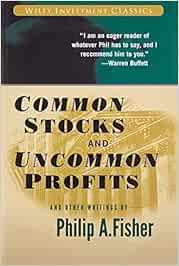
Who is Philip Fisher?
He wrote 'Common Stocks and Uncommon Profits', a book hailed as changing the landscape of investing.
Philip Fisherman is a pioneer in growth stock investing on Wall Street. Are you feeling it slowly?
An economic moat is a concept that is a key driving force behind long-term, large-scale growth, returning enormous added value to shareholders.
If Elon Musk's concept of 'speed of innovation' means to lead the market by introducing better products at a faster rate than competitors, then that is the economic moat.
(It was a meaningless shadow fighting.)
How does an economic moat affect a company's value?
The value of a financial asset is the present value of the cash flow that the asset can generate in the future.
Then, the main factors that determine value will be the size and uncertainty of future cash flows, and opportunity cost. The size of the cash flow can be divided into the size of the cash flow generated each year and the period during which the cash flow is generated.
When we think of growth stocks, we focus on how much they will grow in the next year or so, and not much attention on the predictable period.
In fact, it is difficult to predict how much a company will grow in a short period of one or two years, and if it is a company that is attracting attention, it is not easy to beat others because most investors have an optimistic outlook.
Therefore, even if the company grows, the stock price does not rise much, and the stock price often falls even if the growth rate drops even a little.
How do we determine the predictable period of cash flows, i.e. the period over which a company can generate economic value added (returns above its cost of capital)?
This is where the concept of an economic moat intervenes.
[caption id="" align="aligncenter" width="1200"] Economic Moats Explained: What to Look out for When Investing in Companies[/caption]
There is a captured image that was floating around the market as a joke a while ago.
On the stock board, someone said, "I bought this stock too. But what is the company doing?" , and someone else commented, "I don't know. I'll do anything, Hoesan."
People laughed and passed, but in fact, this statement contains a very important clue.
Stocks are uniquely different from any other asset.
You become the subject of your own actions.
A corporation that becomes an entity of stocks has legal personality and can be the subject of actions.
They make money by signing contracts, making business, and returning the remaining money to their shareholders.
No asset creates value by itself, be it bonds, gold or cryptocurrencies.
Stocks create their own value. Or even destroy it.
In stocks that can be the subject of an action, if the management who decides the action turns their back on the shareholders or lacks capacity,
It will be a battle where all shareholders (except the major shareholders) lose.
Conversely, if a company has a capable executive with a tendency to protect shareholders' interests, investors may think, "It's okay, the company will do whatever it takes" for almost anything.
If you just find a very rare company you can trust, you can create added value for a longer period of time than the market expects.
In other words, the 'long-term upward trend in corporate value' that growth stock investors dream of is possible.
(It is a fact overlooked by many, but just because a company with high growth rates increases over time does not increase its value.
Investors are incredibly relaxed when the corporate value goes upward in the long run.
You may not be swayed by the market. The company will take care of it.
You don't have to do a rigorous valuation of value over time, it will be rising
There is no need to think deeply about the 'trigger' that the market will properly evaluate the value of.
If performance continues and prices do not rise, the gap with value will continue to widen.
Everything the so-called 'growth stock investor' wants to do is here.
So, how do we find an 'economic moat'?
Rich hints lurk in a little-known book called 'Economic Moat' by 'Fat City'
Pat Dorsey is also the author of a book called 'The Five Principles of Morning Star Success Investing', which is considered a textbook for corporate analysis.
In this book, Pat Dorsey says there are four types of moats.
These are intangible assets, customer conversion costs, network effects, and cost advantages.
[caption id="" align="aligncenter" width="957"] A quick multi-thread on Economic Moats by Pat Dorsey[/caption]
Companies with these factors can remain competitive for a considerable period of time.
On the other hand, there are elements that are easy to mistake for a moat but are not actually a moat.
Excellent products, high market share, operational efficiency, and excellent management.
These factors may receive market attention for a short time, but are quickly diluted as competition intensifies.
(The claim that executives are fake moats is controversial. It also seems to contradict Philip Fisher's claims. If you're curious, it's interesting to read the original article and find your own answer.)
Finding an economic moat does not end there.
They also say that moats are subject to change, so keep an eye on them to make sure they are well maintained.
That's why I don't like the 'sleeping pill investment method' that growth stock investors often talk about.
The advice of buying a growing company and holding on to it until the growth is over, deleting the stock app and not looking at the market, is more dangerous than you think.
[caption id="" align="alignnone" width="456"] Margin of safety Conception[/caption]
There is no such thing as a ‘100% chance’ in the stock market
In many cases, the stock price does not rise even if it grows as expected, and if you don't look at the market, you won't be able to see how the company's situation is changing.
It is an investment company that just depends on luck, but according to this principle, the number of trials is long because it is held for a long period of time, so there are not even a few opportunities to correct mistakes.
While holding stock, Peter Lynch said it was important to constantly check that the story he had envisioned was still valid.
Things have changed and it's not good to be stubborn and hold on to it.
Worse, no effort is made to make sure the story is valid.
There is no such thing as a ‘100% chance’ in the stock market, and we have no choice but to accumulate experience by failing over and over again.
Reckless long-term holding is not good for long-term growth as it fundamentally reduces the chance to learn from failure.
Numerous sages and scholars argue that it is difficult to make an excess return above the market average by investing in stocks.
But with a few companies with economic moats that can be found 'within my scope', excess returns are not that difficult.
All you have to do is buy a company with a moat, keep watching to see if the moat holds up, and then sell it when things change (either I'm wrong, the company has changed, found a better company, or the stock has gone up too much).
It's simple
Perhaps the most important thing in investing is finding reasons not to buy or sell, rather than finding reasons to buy or sell.
You can be seen as a mature investor when you can keep observing, but be able to say, 'This is not very important' to the new news every day.
An investment method based on an economic moat is a very comfortable investment method that allows you to pass your time leisurely while increasing the probability of making a profit over time.
It sounds like a lie, but it's true.

Comments
Post a Comment