“Don’t just be a leader”… 5 Exciting Leadership Principles for Coexistence
“Don’t just be a leader”… 5 Exciting Leadership Principles for Coexistence

"David, would you like to take over the design team?"
A year before I heard this, I joined a Series A startup to try to make a great product.
But as time went on, I was more interested in 'how people work' rather than the product itself.
I was interested in how people collaborate to create products.
In particular, I wanted to contribute to making better products by improving the design process, which is my field of study.
At that time, as the company received investment, the size suddenly increased two to three times.
As each product was created by an independent team, there was no one who looked at the product as a whole and cared for the consistency and usability of the product.
I kept raising this issue, and the CEO and CTO asked me to take over the product design team.
When I heard this, I felt like I was recognized, but I was actually worried.
'Can I really do it?'
I never thought about becoming a manager, and I wasn't prepared at all.
Naturally, leaders I had worked with before came to mind.
Like everyone else, there are leaders you really admire and want to follow, while there are leaders you want to avoid, right?
Considering that I must have learned the good and the bad sides of them without knowing it, if I didn't have my own leadership principles, I thought I would follow them without thinking.
That is not a bad thing, but rather than following others, I would say that he wanted to find his own leadership principles that suited the current company.
I didn't want to just be a leader without any preparation.
There is a limit to even asking people around me, so I read about 15 books about leadership and organizational management.
I was curious to see how outstanding leaders around the world manage their teams and companies.
 At first, I started reading books simply to learn a lesson, but as I read, I started to see parts that fit my values and parts that didn't.
The book 'High Output Management' gave me a great insight on how to run an organization efficiently.
On the other hand, treating people too mechanically was something I didn't want to learn, even if it was human at the time.
As I observed the outstanding leaders and the leaders I admired through this book, a common pattern began to appear.
"People must want to follow you."
These are the words of Julie Zhuo, the former chief design officer (VP) of Facebook’s parent company, Meta, who put it together clearly.
'Leaders must earn sustainable trust from team members'
I interpreted it this way.
Leadership Principles based on Trust
Great leaders gain trust first instead of using authority.
A leader should act as a traffic light so that many people can work in 'coexistence'.
1. Trust is unconditional, first
Trust is built when we trust each other. When one person ignores the signal, trust is broken.
To create a psychologically safe environment for everyone at work, we need to trust each other.
Trust doesn't happen overnight, someone has to start believing first.
The most appropriate person would be a leader who acts like a traffic light.
There is one principle I have followed when trusting my colleagues.
[caption id="" align="aligncenter" width="2501"]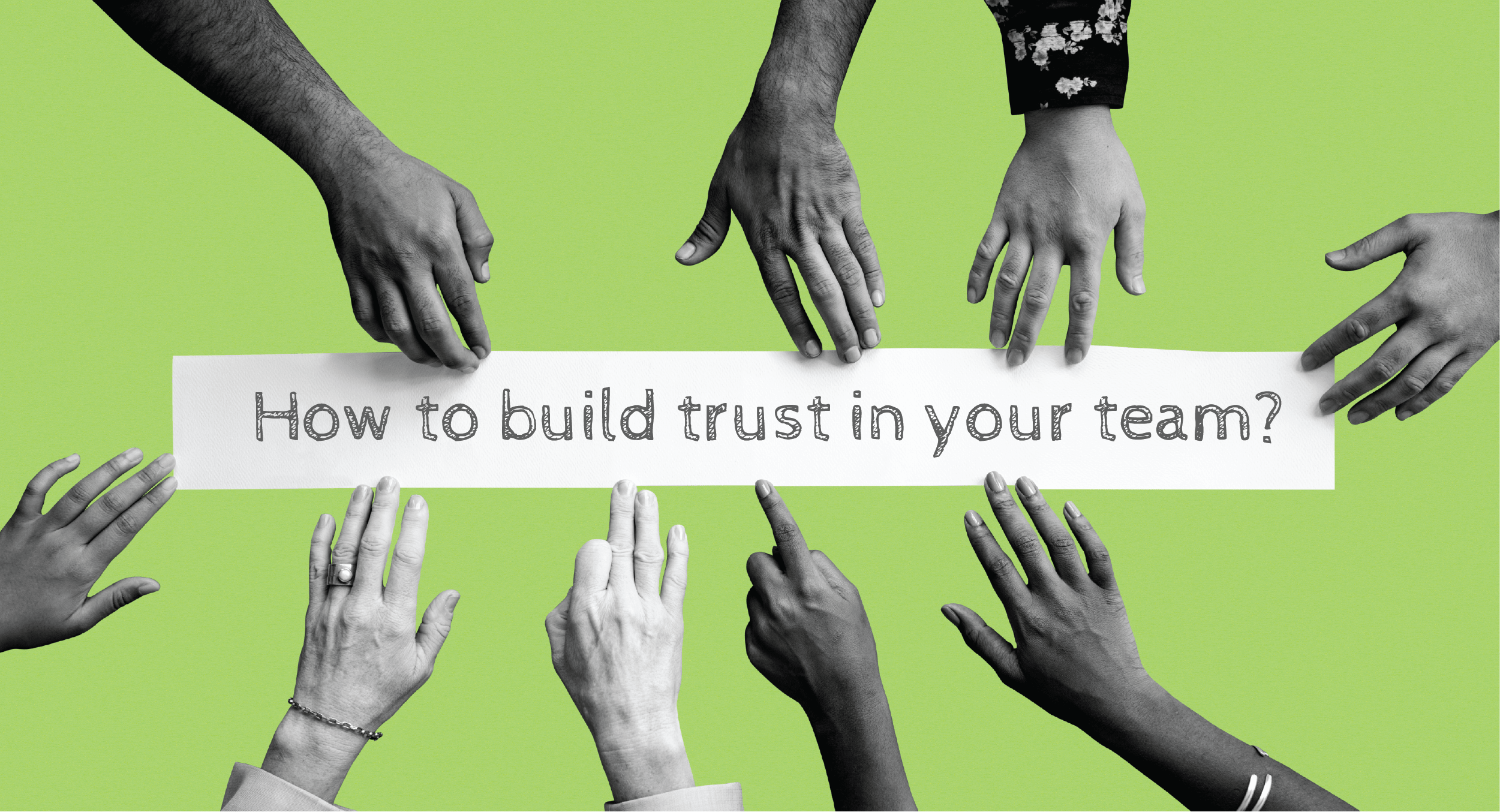 WAYS TO BUILD TRUST IN YOUR TEAM[/caption]
That is, 'Let's not look for reasons to trust in skills or performance'.
When I find a reason to trust in my performance, my attitude changes when that reason is gone.
I thought that if my attention was focused on people who were good at it, people would be marginalized and the team atmosphere would soon be ruined.
I saw that trust starts with 'trusting people rather than skills'
Leaders who act without trust can be stubborn bosses.
Then the question arises as to whether we should trust even the really bad team members without reason.
Considering the reason why I became a leader and the reason why he entrusted me with the leadership position, I thought that I had to have a completely different mindset from working as a team member.
It has now changed to a role that helps multiple people work well rather than doing it alone.
2. Trust is not a one-time thing, but a continuous attitude.
Sometimes it takes boldness and courage to embrace mistakes. So trust should be a 'continuous attitude', not a one-time thing
Actually, I know what to do when a customer says something negative.
What you need then is courage and faith toward yourself, not fear and fear.
In order to have an attitude of constant trust, a leader must be a responsible person.
When a teammate makes a mistake or doesn't meet expectations, you have to wait until you fix it yourself, or sometimes you have to do it yourself.
If the leader himself was not capable and could not take responsibility, it would seem that he would be just chasing his team members to produce good results.
I found the answer to 'Why leaders need to develop their skills' right here.
I wanted to be a responsible person in order to maintain an attitude of constant trust.
3. Trust doesn't just apply to employees
We often think that trust only applies when it comes to the relationship between leaders and employees.
However, trust starts to be built from the 'non-relationship state'.
This is because the 'signal of trust' that the company treats not only its employees but also people gives stability to everyone.
The most dramatic signs of this trust are hiring and firing.
I think we can learn a lot from the way the company treats applicants who are not yet employees and those who will soon be outsiders.
Because 'how a company thinks of people' is the same as the attitude toward its employees.
When Airbnb 2020 mass layoffs due to the coronavirus, the CEO wrote down in detail what the layoffs were and what actions to take on those who left.
Airbnb has prepared a program that gives more severance pay to retirees, releases conditional stocks, and supports employment with other companies without returning their laptops.
Of course, mass layoffs are sad, but the CEO's sincere attitude has softened the hearts of many who have left and remain.
[caption id="" align="alignnone" width="600"] Mass layoffs by Airbnb[/caption]
Not just dismissals, but hiring as well. I have improved the hiring process a lot since taking on the team.
At the same time, one of the things I was most concerned about was 'consideration for applicants'.
We didn't just think about ourselves, we thought about how we would feel as an applicant, what we would like them to have about us, what we could gain from the hiring process, and what we could provide.
In fact, giving the same credibility to applicants with whom you have not yet
It's not easy.
But when the leader showed this attitude, I could see that the teammates felt a great sense of psychological stability.
Because the attitude you show to outsiders, not employees, is your attitude towards real people.
A person who yields his seat to an elderly person on the subway doesn't treat his co-workers like that.
Trust doesn't just apply to our employees, it comes from our consistent approach to people.
4. Leaders need free passes too
Some cars may pass by ignoring traffic lights on the road.
An ambulance or fire engine, which can be life-threatening, can run ignoring the traffic lights.
And everyone gets out of the way for them.
Ambulances get a 'free pass' only in emergency situations.
[caption id="" align="alignleft" width="403"] One of the Leadership Principles of Great Leaders | Empathy[/caption]
That doesn't mean someone blames the ambulance and runs without ignoring the signal.
Even the leader sometimes needs to use the free pass.
For the areas that are still lacking and need to be developed, ask your teammates for their understanding first,
It is a temporary departure from the 'high standards' normally expected of leaders.
I was neither proud nor ashamed of my lack of empathy, but I did not hide it on purpose and shared it honestly.
What was surprising each time was that the other party also began to reveal their weaknesses one by one.
Leaders use pride as collateral to destroy culture.
Will a leader who puts down his pride and communicates honestly will be ignored?
In my experience, I gained more trust when we communicated transparently without hiding our weaknesses.
And if you don't communicate, you can exhaust yourself trying to be the perfect person.
That's why we recommend that you use the Freepass from time to time.
5. Don't just be a leader
As a leader, it is difficult and difficult, so I was drawn to the dual meaning of not just doing it blindly, and thinking and doing if you want to do it, instead of just doing it.
At first, I thought, 'What is it that you just shouldn't do', but when you think about it again, you realize, 'Oh, you have to think and do it'.
I did not see the leader as a position, but as a role.
That way, I thought I would be able to think about what role I should play and find a direction.
As I said at the beginning, after much deliberation, I came up with my own leadership principles of 'coexistence'.
I thought that building trust was the most important thing to create an environment for coexistence.
That way, you can consistently achieve good results.
As mentioned above, I have learned that trust is an attitude and enduring attitude towards people, that you must first trust unconditionally, and that sometimes you can build trust by exposing your weaknesses.
https://www.youtube.com/watch?v=W5qQJhe7sLE&ab_channel=SimonSinek
Working as a Team
There is a saying, 'If you want to go fast, go alone; if you want to go far, go together'.
It's important for a leader to work hard, but it's even more important to be prepared to go far and long with teammates.
To go far and long, a leader needs a person's point of view.
In particular, the more the CEO or a person in a higher position, the more ideas are projected into the organization.
Read More about CEO: How Startup CEOs Master the Skill of ‘Leadership’
The way traffic lights work should be transparent and common to anyone on the road.
So everyone feels safe
The way I think and share is very common, so I thought it would be good for my teammates to work in a psychologically safe environment.
It's like traffic lights on the road don't worry about me in an accident.
So, I first thought of a 'traffic light' as a symbol of the principle of 'coexistence'.
I wanted to create a situation where anyone could see, anyone could understand, and anyone could feel secure.
Today, I've explained to you how I set my leadership principles, how I worked to build trust, and the feedback I've heard from colleagues.
When you're unsure of where to start, one way is to start with the intersection of your strengths and what your teammates want.
Why don't you just set the direction for what kind of leader you want to become, instead of just being a leader? Thanks for reading.

Comments
Post a Comment